



Most people look at four RTX 3060s with 12GB of VRAM each and see a budget build. I looked at it and saw something else: the exact hardware configuration that the current generation of compressed, sparse, speculative models was designed around.
Here’s my argument. With quad Multi-GPU systems, the PCI has been the bottleneck. Each of my cards moves data to the others at roughly 25GBs per second. A single RTX-3090 moves far more internally. So any model that streams its full weight matrix across the bus every single token is dead on arrival. That’s what killed the Quad-3060 experiments back in in 2024 — people were loading four-bit 70B parameter models, which meant 35GB of weight traffic per step. Four RTX-3060 cards barely beat one RTX-3090. The PCI topology lost.
In 2026, two things have changed. First, two-bit quantization. Nemotron 3.5 Bolt at IQ2 is a 22GB file. You’re not streaming 35GB anymore. Second, mixture-of-experts. Bolt activates only a slice of its experts per token — the active weight footprint drops to 2-4GBs which PCIe can actually feed without breaking a sweat. Third, speculative decoding with the LiLiCorr drafter: most tokens get generated by a tiny model that never touches the big one. Your cards spend their bandwidth on KV cache and occasional full passes, not constant weight streaming.
Then there’s context. 256K tokens at eight-bit KV cache is about 16GB on its own. No single 12GB card holds that stack. Four video cards pooling memory is the only consumer path to it. My Threadripper AI rig isn’t four small machines pretending to be one big one — it’s one memory pool that happens to be built from four RTX-3060 cards.
And this isn’t a one-off. NVIDIA’s compression recipe — take a parent model, distill it to two-bit, ship it with a drafter — is repeating every cycle. Super VL to Bolt, Bolt E4B dropping this week at 4GB. Diffusion models with open weights are coming. Every memory crunch pushes AI labs toward exactly this class: sparse, quantized, speculative. Abundant memory via multi-gpus, modest bandwidth, software trading compute for VRAM capacity.
Their Super and Lightning models ship with native multi-token prediction heads and NVFP4 quantization — same compress-then-quantize philosophy, just aimed at bigger hardware. They’re taking something big, compressing the architecture, quantizing hard, and bolting on a speed layer. That’s the whole game now, and my four RTX-3060 cards are the ideal testbed for these new mid-range models.


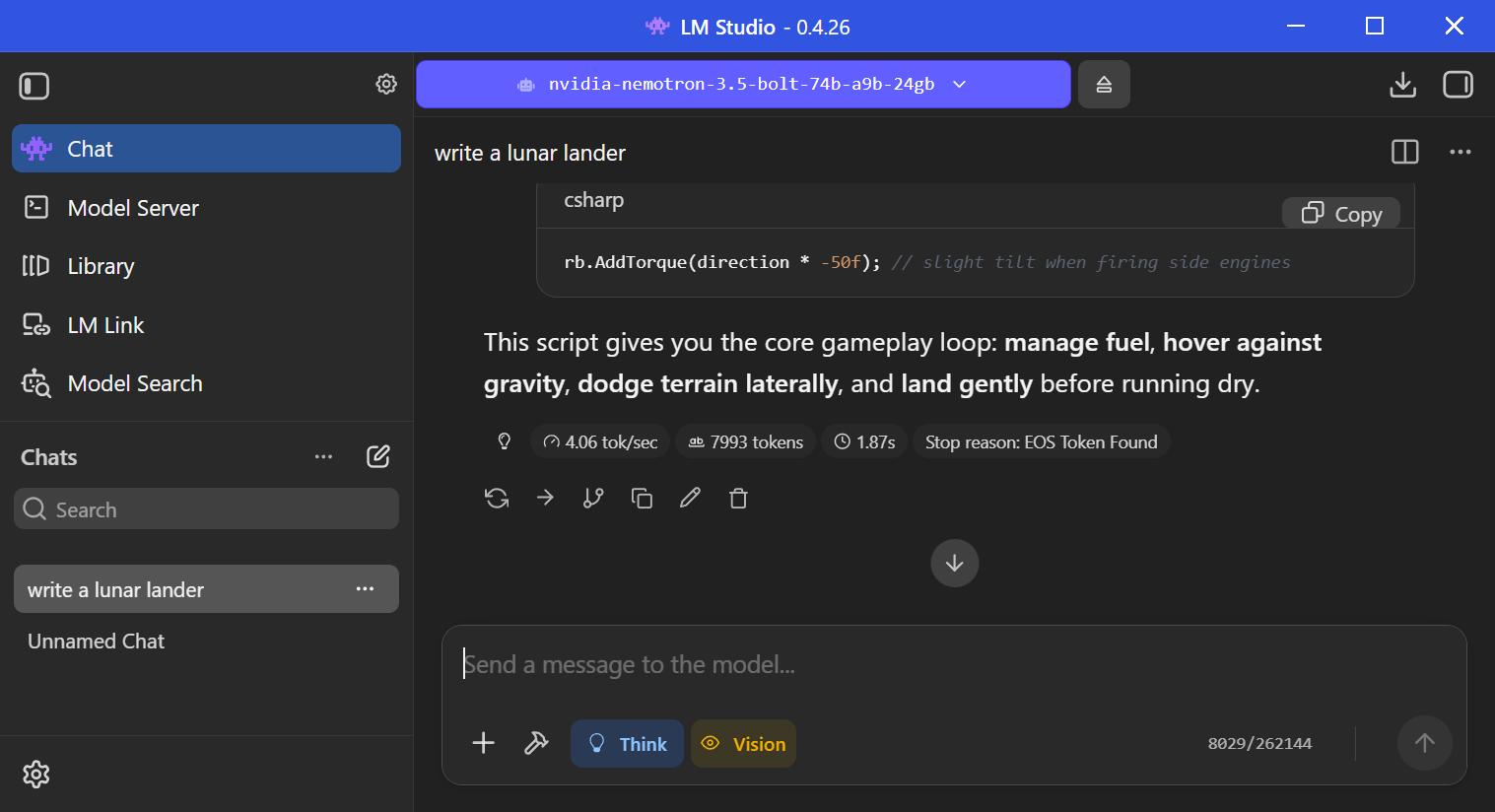

With my standard Lunar Lander Game test, i was able to get 4 tok/sec with a large 128MB Context Window. I’ll do some more testing in the future with LiLiCorr drafter turned on to see if I can speed up the this sparse, quantized, speculative local model from NVIDIA.